Oct 21, 2014

Hohenschwangau


Ok, it's finally time for the next castle!


     We won't go far. Just 2 kilometres from Neuschwanstein, you will find another castle associated with Ludwig II and with a name difficult to pronounce: Hohenschwangau (/Hoenʃvʌngʌʊ /). Hohenschwangau means "High District of the Swan" and it was probably named after the lake nearby (Schwansee) where Ludwig's mother would take him to feed the swans in his childhood years. The swan would later become an important motif in his castles.


     I visited this castle twice too, both times just before heading to Neuschwanstein. I'd guess that's the usual order of seeing these two castles. After all, Hohenschwangau is situated on a lower hill.

     But before talking about my experience, let's just write few words about the history of this castle. The main difference between this one and Neuschwanstein is that the latter was was built by Ludwig II himself, while the former was built by his father, Maximilian II of Bavaria. Or to be more precise, they gave orders to build the castles. The only thing Ludwig II made in this castle were the twinkling lights on the ceiling of his bedroom.

 
                                                                    A closer look of the castle

     At that time, Bavaria was an independent kingdom. Maximilian was one of those people who was fighting against the German unification and was very proud of his Bavarian heritage which he tried to advocate as much as possible. That is why you can see many Bavarian symbols and scenes from Germanic mythology in this castle.
     He also showed great interest in a wide range of arts, namely literature; he was a great fan of Hans C. Andersen who actually visited him in Hohenschwangau castle.

                                                  
     And just like his son, Maximilian II went on to build and rebuild few castles in the area, with Hohenschwangau being the most notable of them. The first records actually date from 12th century, but Maximiliam II completed the restoration in 1855, more than 20 years after acquiring the ruins and the area nearby.
     He decided to create a picturesque castle with decorative elements such as towers and turrets, oreils, portals, balconies, pillars...

Young Ludwig II building his first castle :)
 The photo of young Ludwig II was found on this site and it features this very interesting story: 
 http://radiustours.wordpress.com/tag/christmas/

      "One of my favourite Ludwig stories is from the Christmas of 1852, when the 7 year old who would later become mad King Ludwig II received as a fateful present from his grandfather, mad King Ludwig I. A set of building blocks.
     This fired the childish imagination of young Luddi, and may have unlocked something deep within. “He loves to build,”  wrote the impressed grandfather to his son, the child’s father Otto: “I witnessed him construct buildings that were exquisite, astonishing, and realised with excellent taste.”

“I recognise a real affinity between this future King Ludwig II and myself,”..."

Yep, it runs in the family. Ludwig I was an art lover and he built numerous buildings in neoclassical style, most of them in Munich. Another trivia related to Ludwig I: On the occasion of his marriage on a huge meadow outside of the city walls of Munich on October 17, 1810, the first Oktober was held! Castles + Oktoberfest - Bavarians living today should certainly thank this royal family.


     Hohenschwangau was the official summer and hunting residence of the king and his family and it feels more spartan (but don't expect Middle Ages!) compared to Neuschwanstein and other castles that Ludwig II built himself. 
     After the death of his father, Ludwig II took over his father's room (he lived in an annexe next to the castle before that) and lived together with his mother. From 1869 until his death in 1880, he closely inspected the construction of Neuschwanstein from this castle.

     Unlike Neuschwanstein which was sold to the Bavarian Government, Hohenschwangau is privately owned by the family and I guess that is the reason why more rooms are not accessible to the average visitor.

                                                              Yes, the telescope is still there!

     As said when writing about Neuschwanstein, you can only visit this castle as a part of rushed guided tour. 
     So the first thing that caught my eye was this huge guest book in the Reception Room and yes, I did manage to take a photo of it (hopefully the family won't sue me :D)! Another interesting trivia: the protestant reformer Martin Luther is said to have taken refuge at this castle while hiding from authorities on his way to Wittenberg to nail his Ninety-Five Theses to the church door. Since he was hiding, he naturally didn't sign, so it is always open for speculations I guess...


     On a side note, writing this entry very late after the first one made me realize how much have I already forgotten :( While I hate taking hundreds of photos, it's good to have some to jog your memory, if nothing else. Another important detail I managed to catch on my camera was Wagner's piano. It is placed in the dressing room, but it served as Ludwig's music room too. Wagner most probably played in it just for Ludwig's pleasure.


     What I liked in this castle was the contrast between public and private rooms. The private rooms aka bedrooms are much warmer in its exposition and images than the public ones, especially The Hall of Heroes, which looks like a show-off piece in my opinion. While public rooms are often decorated with war and battle images, the king's bedroom is inspired by Italian Renaissance and depicts naked girls having a good time. The colours are just gorgeous.

                                                                    
     The queen's bedroom is even more elegant, obviously inspired bythe Moorish style. Perhaps my favourite room in this castle. 


     It is obvious that someone lived there once upon a time. I can't say the same for Neuschwanstein- just think of the Throne Hall without a throne!
     In the castle ground there is a souvenir shop which is expectedly overpriced. I bought one horseman only to realize few months later that the same one can be bought in China shop for much less :( Well, I was young and naive, I wouldn't do the same mistake again. Besides, nowadays I rarely buy souvenirs as most of them just collect dust on shelves and I barely look at them. So unless it's something unique and it really grabs me, I don't buy it. My friends are not happy about that, he he... I rather buy books about the places I've been to, it's far more useful and I actually read them.

     Many tips that I have written about Neuschwanstein apply for this castle too. While Hohenschwangau receives a fraction of Neuschwanstein's visitors (300 000 compared to 1.3 million), it can still get very crowded and buying your ticket online in advance is usually a good idea.

Visitor info:

a) Opening hours:

The castle is open every day except on December 24.
From March 28 to October 15: 8:00-17:30
From October 16 to March 27: 9:00-15.30

b) Admission

Visit of the Tower plus a guided visit to the Apartments and the Cellars:

 Adults                                                                                    € 12.00                 


Students, Senior citizens over 65 years of age,
disabled visitors when showing valid identification
€ 11.00
Groups, at least 15 members € 11.00
(This discount only applies if all tickets are bought and
paid at the same time by one person)
• Travel guides and coach drivers free

c) Contact

Official website: https://www.hohenschwangau.de/556.0.html

Adress

Ticket-Center Hohenschwangau
Alpseestrasse 12
D-87645 Hohenschwangau 

Telefon: +49 (0) 83 62 - 93 08 30
Telefax: +49(0) 83 62 - 93 08 320 


d) Multimedia: 

1. Ludwig II (1972)


Neuschwanstein

Neuschwanstein Castle


Hello people, finally.

It's time for Ludwig II castles tour and I will start with the most famous one: Neuschwanstein. Pronounced something like /noiƒvanƒtaIn/ and meaning "New Swan Stone Castle", it is one of the most popular tourist destinations in Germany and one of the most visited castles in the world today.
     I was lucky to visit the castle twice and it was a wonderful experience each time, despite the crowds. The first time I went with the bus tour and the second time I went solo. Going solo is definitely much better because it allows you to stay longer and move on your own. But only on the outside! And do you know why? Because you cannot go inside the castle solo. To see the rooms in the castle you have to be a part of a guided tour. For me, that is the only disappointing thing about visiting this wonderful castle. Oh yeah, taking photos inside is forbidden too, but I did manage to take a snap or two.


I realized this castle is so famous that you probably can find tons of information about it online, so if you are unfamiliar with the castle, here is just a short trivia:

 -in the 19th century, many castles were constructed or reconstructed; often with significant changes to make them more picturesque (aka fairy tale castles)

- built from 1869-1892, only about 15 rooms and halls out of more than 200 planned rooms were finished before Ludwig II, the king of Bavaria died

- since Ludwig was not interested in politics and ruling, he imagined Neuschwanstein as his private retreat where he would enjoy the nature, architecture and the music of Richard Wagner

- in fact, the king was Wagner's patron and Richard's operas served as a major inspiration in designing some of the rooms in the castle

- during the building of the castle, many considered it to be a kitsch, particularly because you can see Romanesque, Gothic and Byzantine architecture mixed with, among others, oriental element

-  less than two months after Ludwig's death, the castle was open to paying visitors. They smelled the money immediately!

-  during the World War II, when Hitler needed a place to store the art he had stolen from museums, he used Neuschwastein as he supposedly believed no one would dare to destroy such place. I guess he was right! This is recently covered in George Clooney's The Monuments Men.

- around 200 000 people visited the castle in 1939, now that number has risen above 1.6 million


                                                                       One side of the castle

     So, how about my experiences? Well, let me tell you that I enjoyed visiting the castle in spring much more. I loved the contrast between the greenery and the limestone. In November everything was quite grey and a bit snowy, so the castle didn't stand out as much. The first time I was part of a bus tour coming from my own country, so I didn't have to worry about anything. We visited Hohenschwangua first and then proceeded to Neuschwanstein. Since it was November and it was like 6 years ago, there weren't many crowds. I was really impressed with the interior. I think it's good to start with Hohenschwangau as it gives you a bit of insight what to expect in Neuschwanstein, but the former is more spartan (for Ludwig's standards). The tour lasted for half an hour and the guide was telling a lot about Ludwig II's life too. The most unusual room is certainly Grotto, which is is actually an artificial cave. Built into the castle between the living room and the study, the cave is illuminated with various colors and even has stalactites and a small waterfall! Again, this was inspired by Wagner's opera.
     Rarely do you have a castle so tightly connected with its owner. He was completely involved in every detail regarding the castle, who knows how many great castles he could have built. Contrary to the popular belief, he didn't use public funds to build this castle. He was also supposed to be in love with the famous Sissi, homosexual and lunatic. Eh... there is always so much drama and speculation about famous and interesting personalities. While we were approaching the castles, the guide was telling us everything about his life, his relation to other royals and history of Bavaria. Very informative, but when you hear about most of those names for the first time, it's not easy put the pieces of the puzzle together. So maybe reading a bit about Ludwig before visiting the castle prove useful.
      On our way back, me and my family shared a horse-drawn carriage with an elderly German couple. They were very amused by my attempt to eat sausage with ketchup. Yeah, I made a mess and they couldn't hold back the laughter.
      On my more recent visit, everything was green, green, green. So relaxing. I was in Munich for a couple of days and I wanted to get the views of the castle from Marienbrucke. So this is how it looked like:


                                     The view from Marienbrucke- in the meantime, the scaffolding is gone :)

I didn't go inside this time, but I will post some pics I took few years ago later.


Neuschwanstein tips:


                                                                    Yes, you are getting closer!


1. Buy your ticket online
     It is one of the most popular destinations in Germany, God knows how much you'll have to wait. I would suggest buying combined ticket with Hohenschwangau Castle, which is just nearby and gives you a better insight into Ludwig II's life and it's a nice castle after all. If you are crazy about Ludwig II and his castles, there is a combined ticket for all 5 castles. I must add that the entrance fee is going up quite often. Regular ticket for Neuschwanstein  costs 12 EUR, reduced 11. It is becoming a tourist trap, but what can you do.   
     You must book online at least 24 hours in advance and there is a small fee per person for the advanced booking. When you get there, go to the reservation counter and pick up the tickets.

Alternative: You can go there and try to buy them. It might not be a bad idea if you are visiting in October-March period. You can work out your time based on the time of your entrance. But my friend was there last September and the line to purchase same-day tickets was about 2 hours long, with tickets only being available for 6 hours later.


2. Be ready for some walking
Hohenschwangau village and the namesake castle
Both of these castles are up the hills. While for average person the walks and climbing those stairs in around the castle should not be a problem, it MIGHT be for someone elderly. A family friend of mine has asthma and she felt bad at Hohenshcwangau and was quite tired afterwards. If you have such problems, don't rush yourself. Remember that you have many steps within the castle too. Anyway, walking is the best way to visit these castles. The walk up the hill took about 20 - 30 min. You have some at least one restaurant on your way up (or down).
     Soak up the peaceful atmosphere, move away from the crows and don't forget to go to Marienbrucke (Queen Mary's Bridge) for the most spectacular view of Neuschwanstein. If you want to visit Marienbrucke, take the bus up the hill as the bus stop is closer to the bridge than the footpath route.

Alternative: There are buses (1.9 EUR up, 1 EUR down) and horse-drawn carriages (I think 5 EUR one-way). Bear in mind that in case of snow and ice buses do not run.


3. Follow the guide

As you already know, official tour is the only way to visit the rooms inside the castle. The tour is quite short, but pretty informative (this basically depends on the guide). If the group is larger and you want to follow everything your guide says, try to be just behind his back. As I already mentioned, taking photographs is forbidden, but they won't attack you if you try. Still, there are quite a few guards, so try to be discreet because otherwise it can be pretty embarrassing for you and annoying for the guard. Just imagine how many stupid tourists (like me :)) try to sneak a photo or two. 
Alternative: Hang back and try to be one of the last to leave each room to have a better look of the rooms. You may even sneak a photo or two just before the next group fill the room. Here are my results:

                                        Not good, man. Not good. I had a really bad camera back then.


Much better attempt! Study room

I have a funny little story behind this last picture. My mother was trying to sneak a picture of Singers' Hall, the largest room in Neuschwanstein. Most of the crowds (except for omnipresent Asians, as oyu can see :)) finally left the room and just when she was about to push the button, she heard: "No pictures please!" My mother started cursing in our (Croatian) language, babbling that she is trying whole day to take one good photo from the inside, so the poor female guard said: "Jedna, jedna, moze jedna!" (One, one, one is okay), implying that we are allowed to take one picture of the room. I was quite embarrassed and told my mother that the reputation of the people from Balkans is bad enough and that everyone knows about our curses lol... So, I guess there is a way to take pictures after all :)
     Anyway, the picture don't do any justice- the whole interior is rich in details, colours and it's really shiny. But personally, I would never want to live in a castle like this, there is absolutely nothing homely and cozy. It is very obvious that Ludwig was channeling medieval castles to every detail. He improved the richness, but not the comfort I'd say.


4. Keep your expectations (relatively) low
The spectacular setting of the castle, the unique exterior and rich interior are absolutely worth visiting. Are you going to like it? Most probably yes. Things that might take away from your experience are the crowds, waiting (for buses too), costs and the duration of the tour (about 35 minutes). Also, bear in mind that this castle was never used as a "castle". It was intended as Ludwig II's residence, it was his dream to live in such "castle". If you have a feeling it looks too new, well it is. It is just 120 years old. So don't try to compare it to real castles. This one had a toilet with an automatic flushing system!
Alternative: Act like a real tourist. Be completely overwhelmed, take gazillion of pictures like the Asians do, or just utter "amazing" and "beautiful" every few minutes like the Americans do :)


How to get to Neuschwanstein by public transport?


Since I was based in Munich, here is how I did it. You have a train + bus connection to Fussen about every hour or so. The journey lasted more than two hours by train (I think). Make sure that you catch the direct train to Füssen which runs every 2 hours (07:50 and 09:50), otherwise you have to change trains additionally.
In Fussen I took bus 73 to Steingaden/Garmisch. You can also catch bus 78 to Tegelbergbahn. The bus stop is called Hohenschwangau, Schlösser.
Unfortunately, transport in Germany is expensive. I paid around 20 EUR for one-way ticket + few more euros to reach Hohenschwangau. So, about 50 EUR return. However, you can save money if you buy Bavaria ticket, it costs 22 EUR for one adult, or 38 EUR for up to 5 adults. You have to return on the same day. Children up to 14 years travel for free with their parents or grandparents. You can purchase the Bavaria ticket online or at ticket machines. It is valid from 9am to 3am the next day on all regional trains and most buses (not on ICE & IC train).


                                       View of Marienbrucke from the entrance of Neuschwanstein


Visitor info:

a) Opening hours

Tickets on sale:
April to 15 October: 8 am-5 pm | 16 October to March: 9 am-3 pm

Opening hours of Neuschwanstein Castle:
 April to 15 October: 9 am-6 pm | 16 October to March: 10 am-4 pm
open daily except 1 January and 24 / 25 / 31 December.

b) Admission

12 EUR regular/11 EUR reduced
Children and young people under 18 enter for free.

Combined tickets with other Ludwig II castles are possible.


c) Multimedia

Neuschwanstein has been used as a filming location on quite a few occasions, most notably in:

1. Spaceballs (1987) -featured as the castle of Druidia

http://www.imdb.com/title/tt0094012/reference

2. Chitty Chitty Bang Bang (1968) -perhaps the most famous use of Neuschwanstein on film

http://www.imdb.com/title/tt0062803/reference

3. Ludwig II (1972) - the lengthiest use of the castle on film? I own the 4-hour version of the film and supposedly all of Ludwig's castles are used as filming locations. I still haven't seen it though.

http://www.imdb.com/title/tt0068883/locations

4. Ludwig II (1955) - German biopic

http://www.imdb.com/title/tt0047195/reference

5.  The Wonderful World of the Brothers Grimm (1962)

http://www.imdb.com/title/tt0056700/reference

5.  The Monuments Men (2014)

http://www.imdb.com/title/tt2177771/reference

There is even a video game which features Neuschwanstein- The Beast Within: A Gabriel Knight Mystery. Too bad I'm not a gamer, though. It sound very intriguing!

 http://en.wikipedia.org/wiki/The Beast Within: A Gabriel Knight Mystery


So, what are your thoughts on Neuschwanstein? Have you visited it already? Did it exceed your expectations? Tell me about you experience!

Nov 1, 2012

Fairy tale castles

   
While I was reading quite extensively about Ludwig's castles, this term was brought up many times: a fairy tale castle. Neuschwanstein is the one this term referred to most, for all the obvious reasons. As you might know, Neuschwanstein, among many other real and fictional castles, inspired the design of castles in some of Disney' animated movies and theme parks.
     I realized that our perception and desire for pretty castles is influenced by Disney and his animated movies to a large extent. Or am I wrong? Most medieval castles were actually rather large forts that bear little resemblance to our idea of a fairy tale castle. Those conceptions come from the far more recent Romantic period (1840-1880) when the truly dark and barbaric Middle Ages were recast as a time of magic and wonder. It is no wonder that Ludwig's castles were erected in the period where many castles were constructed or reconstructed, often with significant changes to make them more picturesque. So the truth is, most of these "pretty" castles are redesigned because it was fashionable at that time. Now that doesn't sound too romantic, does it?
     So what are some of the typical features of a fairy tale castle? Tall, possibly round stair towers, crow stepped gable, courtyards, portcullis, exaggerated and pointy turrets, circular battlements, bunch of not too big windows. Dramatic location with great views, moat or gardens help too. On top of everything, it shouldn't look neglected and it has to have a little bit of extravaganza. A fairy tale castle is about exterior by all means. By all means, a fairy tale castle is about exterior. To see if this is true, I searched through many castles to see if I support the concept.


                                                          Exaggarated and pointy turrets           


                                           It's hard to imagine a fairy tale castle without towers, right? :)
                                                                       Broadway Tower is shown on the picture.


                                                      Portcullis adds to the mystery of the castle.


So here are my top 15 fairy tale castles (in no particular order) :


Neuschwanstein, Germany


It is hard to deny it, this castle has all the elements of a fairy tale castle. It may not be the prettiest castle if you focus on details, but as a whole it is really stunning.


Alcazar of Segovia, Spain


Despite not being extravagant and looking a little dull on the outside, Alcazar of Segovia has enough features to qualify as a fairy tale castle.


Lichtenstein, Germany


A smaller version of Neuschwanstein. I love this castle.


Peleș, Romania
 

Quite different from the three previous castles in architecture, style, with more details and prominent use of wood, Peles castle certainly qualifies as a fairy tale castle.


Hohenzollern, Germany


This huge castle complex maintains very harmounious appearance, and with its numerous towers and gates, this one makes a perfect fairy tale castle.


Trakai, Lithuania


I think I consider Trakai a fairy tale castle because of two things- these lovely red rooftops and beautiful location. It certainly doesn't look rich or delicate, but it has its own merits.


Egeskov, Denmark
 

      I am not really sure why I consider Egeskov a fairy tale castle. Perhaps because of the water? Anyway, I find it very, very charming.


Hunyad Castle, Romania


          A perfect candidate for goth fairy tale.


Palazzo Ducale, Italy


Palazzo Ducale technically cannot be a fairy tale castle because it's actually a palace. But since this blog is about castles, forts & palaces, I can put it here :) The main reason is obviously beautifully decorated façade.


Grand Palace, Thailand


    Well, not all fairy tale "castles" have to be from Europe. The picture actually shows just one building in the  palace complex. Some might think it's kitschy, I find it nicely decorated. Rooftops are the main highlight.


Bojnice, Slovakia

                                                     Another "typical" fairy tale castle :)


Himeji Castle, Japan


Among relatively similar Japanese, Chinese and Korean castles, Himeji Castle is the only one I would describe as fairy tale. Again, I am not sure why, but it looks very elegant and white color definitely adds to it.


Castel del Monte, Italy


        Yep, this is one of my fairy tale castles! Simple and classy. Circular courtyard inside is fabulous.


 Belém Tower, Portugal


Some might be surprised that I chose this tower instead of Pena Palace, but the latter is too messy and kitschy IMO to call it a fairy tale castle. This one is the complete opposite and these bastions are adorable.


Royal Palace, Cambodia


  The roof is so lovely. It wouldn't be hard to imagine a princess walking down the staircase at any moment. 


     Browsing through these castles, it would be hard to determine my own definition of a fairy tale castle. Despite a good number of central European castles for which this term is most used, my choices are quite diverse. Also, many people refer to British and Irish castles and fairy tale castles, but I just don't see it. Apart from exquisite locations, a large majority are either ruined or too dull from the outside for me to even put them into consideration.

I would really appreciate your thoughts and opinions about this subject :)


Sep 28, 2012

Top 10 most famous castles in Provence

     While Provence certainly doesn't offer France's best and most impressive palaces, there is one worth your attention: Palais des Papes or Palace of the Popes. You can read about my detailed visit on the site. Still, Provence has plenty of castles and forts which might please you, standing as witnesses to the tumultuous history of the region. But don't expect any extravaganza, their main purpose of these buildings was military and it shows.
     Unfortunately, except for the Chateau d'Uzes, I wasn't able to visit any of them. I planned to visit Chateau d'If, but the sea was rough and I passed by Tarascon castle, which looks mighty impressive from the outside. So here is the Top 10:


1. Palais des Papes


 http://www.palais-des-papes.com/


2. Château d'If


     François I, in the 16th century, recognized the strategic advantage of an island fortress surveying the mouth of Marseille's vast harbor and built this imposing edifice. Its effect as a deterrent was so successful that the fortress never saw combat, and was eventually converted into a prison. It was here that Alexandre Dumas locked up his most famous character, the Count of Monte Cristo. Though the count was fictional, the hole through which Dumas had him escape is real enough, on display in the cells. On the other hand, the real-life Man in the Iron Mask, whose cell is also erroneously on display, was not imprisoned here. The IF Frioul Express boat ride (from the Quai des Belges, €10; for information call 04-91-46-54-65) and the views from the broad terrace are worth the trip. The site is more about the scenery, don't expect much inside :)

http://if.monuments-nationaux.fr/en/


3. Les Baux-de-Provence castle 


     Erected during the 10th century above the namesake village, this castle reached its peak during the medieval period until it started to decline in 16th century because of family feuds and religion wars. Despite its prominent military role, it was also here that the most famous minstrels and troubadours of the day sang songs of courtly love to the maidens of the House of Les Baux. While the chateau (as you can see) is in ruins, you still  get a strong sense of this atmospheric, impregnable, slightly sinister fortress riddled with dungeons, chapels and secret passages. From April to September many shows are held there, from siege machinery, the archery to treasure hunt for children.

http://chateau-baux-provence.com/en/home


4. Tarascon castle


     Built on the banks of the Rhone, the castle of Tarascon defended the access of the possessions of the counts de Provence. The basics of the castle were placed in 1401 by Louis II of Anjou, after the previous castle was destroyed. The construction was continued by his first son, Louis III of Anjou and was completed in 1449 by his second son, René I of Naples. However, after the 15th century the region became a part of France and thus the castle was no longer of particular strategic importance. In the 17th century it was turned into a military prison and remained to function as such until it became national property in 1932.
     Today the castle can be entered through a restored bridge, parts of which are from original drop-down bridge of the building. It houses a nice collection of tapestries from the 17th century, with the whole interior being far more delicate than it appears from the outside.

http://chateau.tarascon.fr/


5. Château de la Barben


     Anchored on huge rocks, this castle is first mentioned in a 1064 property register from the abbey of St. Victor of Marseilles. A then-fortress was owned by King René (yes, the one who finished the Tarascon castle!) until he sold it in 1474. The château was completely transformed due to an important rebellion against the "Édit des Élus" (Edict of the elected concillors") issued by Richelieu in 1630. During the rebellion, a gang known as "Cascaveous" set fire to the nearby forest and a part of the fortress. King Louis XIII condemned the Aix communities which had participated in this riot to give compensation to Gaspard de Forbin to restore his castle. In the Age of the Enlightenment Barben was turned into a castle where austerity and classicism were combined to give this building the appearance very similar to what you see today (that's what it says in the brochure).
     The castle is commercialized to death with many different tours, activities, medieval market, zoo, castle B&B... No offense, but this seems too much, at least on paper.

http://www.chateaudelabarben.fr/


6. Château du Barroux


     This castle was built in the 12th century to oppose Saracen and Italian incursions. In 1274, as the Pope took possession of the Comtat Venaissin, Le Barroux became a fiefdom dependent upon the Apostolic Chamber of Carpentras until 1791, as the Comtat was joined to France. So, the tenant of the fief of Le Barroux was listed among the lords vassals and feudatories of Our Holy Father the Pope. It went through major overhauls in the 16th and 17th centuries, ultimately being abondoned. The castle was damaged during the French revolution and repaired in 1929 using private funds. It was set on fire by German occupation troops in 1944 as a reprisal for acts of resistance and restored again after 1960.
     Since 1993, the Association of the Friends of the Castle of Le Barroux has been continuing this work, with the support of the family Vayson de Pradennes, which still is the owner of the castle. Even though everything is not finished yet, the castle can now welcome its visitors and offer a splendid setting to various cultural and artistic events as well. Happy ending, I guess :)

http://www.chateau-du-barroux.com/


7. Fort Saint-Jean


     Situated at the entrance to the Vieux-Port of Marseille, this fort was built in 1660 by Louis XIV in response to a local uprising against the governor. In 1790 Fort Saint-Jean was seized by a revolutionary mob who decapitated the commander of the royal garrison. During the subsequent French revolution the fort was used as a prison, holding Louis Philippe II, Duke of Orléans, and two of his sons. Following the overthrow of Robespierre in 1794 about a hundred Jacobin prisoners held in the fort were massacred. Throughout the 19th and early 20th centuries Fort Saint-Jean was in the possession of the French Army and served as a final stop-off point for French Forein Legion recruits destined for basic training in Algeria.
     During World War II Fort Saint-Jean was occupied by the German military in November 1942. In August 1944 during the liberation of Marseilles, the explosion of a munitions depot within the fort destroyed much of its historic battlements and buildings. Although returned to the French Army, Fort Saint-Jean remained in a neglected and disused state until it was passed to the Ministry of Cultural Affairs in 1960. Classified as a historical monument in 1964, the damaged portions of the fort were reconstructed between 1967 and 1971.
It now houses the Museum of European and Mediterranean Civilizations.
     While I was in Marseille, the fort was undergoing major restoration, just like much of the city. As you may know, Marseille will be the European Capital of Culture in 2013.


8. Château de Lacoste


     This castle definitely owes the fame to its owners. The infamous Marquis of Sade moved into this castle in 1771 in an attempt to escape the scandal he had provoked in Paris. The Marquis had inherited this castle from his grandfather in 1716, but only stayed in it for seven years. The building originally had 42 rooms, a theatre and a chapel. The castle was pillaged during the French Revolution and finally demolished in 1816, with its hewn-stones being sold piece by piece. For 30 years, the last owner pursued the castle's restoration, which was extremely difficult due to its extremely poor condition. In 2001, Pierre cardin bought the castle and started with renovation work. In summer each year, he organises a musical artistic festival in the quarries to the west of the castle. The picture shows the castle before the restoration work.

http://www.festivaldelacoste.com/


9. Chateau de Gordes


     Located in the middle of one of the most beautiful and famous villages in the whole France, the history of this castle dates back to the 11th century. Besieged unsuccessfully during the Wars of Religion, it was the stronghold of the Marquis de Simiane, the Dukes of Soubise, and in the 18th century the princes of Condé. Rebuilt in the Renaissance style by Bertrand de Simiane, the castle has had two different faces since then. In 1931 it became a national property. After hosting a museum dedicated to the work of Victor Vasarely from 1970 to1996 , it now houses, in addition to the tourist office, an art museum dedicated to the work of Pol Mara.


10. Chateau d'Ansouis 


     The castle, like virtually hundreds in Provence, stands above the village on top of the hill. It dates originally from the 10th century, but it has been modified many times since, principally because the original defensive role was lost (originally the castle protected the road between Aix-en Provence and Apt). Much of the castle we see today, including the main facade to the south, dates from the 17th century, as do the furnishings and tapestries that furnish the interior (although significant parts of the earlier fortified castle can still be seen as well). The typically 'French style' Provencal gardens and terraces around the outside are also very attractive, while the views from the terrace across the surrounding countryside are also exceptional. A guided tour is available from April to October.


     Yes, you have to admit that Provence is not the best destination for castles, forts and palaces, but if you are history buff, you have plenty of Roman ruins (Antique theatre in Orange, Pont du Gard, Arles & Nimes arenas, Glanum...), abbeys (Senanque, Thoronet, Montmajour, Saint-Michel de Frigolet, Saint-Roman...), museums and churches to please you!
     With my next blog entry I will start presenting the castles of Ludwig II of Bavaria: Neuschwanstein, Hohenschwangau, Linderhof, Herrenchiemsee and Nymphenburg. It's going to be a lot of work, that's for sure!


Aug 21, 2012

Chateau d'Uzes

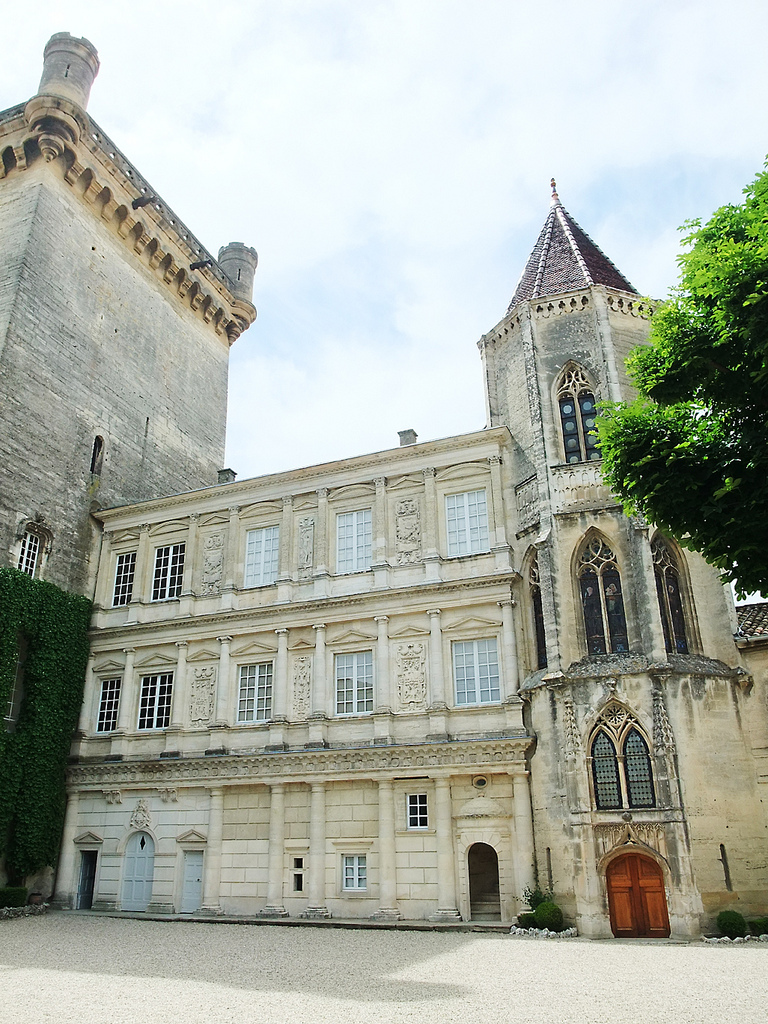
  Ornate rooftop of the Chateau d'Uzes

Chateau d'Uzes was my second and last castle that I visited while being in Provence. Bear in mind that Uzes is a part of Languedoc-Roussillon region, not Provence. Located in Nimes, I was ready to leave this place after Day 1. I had high expectations of the city, mainly because of the Roman heritage and gardens, but it turned out to be the most disappointing part of my lovely trip. So here is how it went: in the afternoon of my second day, I decided to take a bus to Pont du Gard, but I missed it. I was going through the timetables, with Uzes being the only place I have heard of, so it was a no-brainer really. I remember reading about a castle or something similar being there. The only problem was that I had max. 45 minutes to see it, since the lines were very infrequent and the last bus from Uzes was leaving around 18.30 or so. I was ready to take an almost one-hour ride rather that spend more time in Nimes. And it was a good decision. Pleasant town, pretty scenery. On top of everything, Nimes-Uzes bus cost me just 1.5 euros!

Let me just add that on Day 3 I wanted to visit La Bambouseraie, but I went to Pont du Gard instead. You wanna take a guess? Yes, I missed the bus again!


       The chapel is on the right

Okay, back to Uzes and its castle: Since I had no idea where the castle is situated, I was a bit worried about my plan. As the bus was approaching the town, a few towers arose above the houses, so everything was fine. Still, I had no time to waste so I got out of bus and rushed to find the castle. It was maybe five minutes away from the bus station, so I got there pretty quickly. Another problem emerged: the woman working in the souvenir shop (at least I think it was) and who was in charge of selling tickets spoke French only. I got a bit dizzy looking at the prices. I wasn't sure if the castle was still working, but after a few minutes I realized I have to pay 12 EUR just to climb the tower. Since I was in a rush and it's still a fucking castle, I spat out the money and started my solo tour. Naturally, I was the only visitor. Out of the five or so entrances, I was allowed to enter two: the rest were reserved for a guided visit including apartments, wine cellar and the chapel. Actually, maybe I was allowed to enter the chapel, but that lady  made no effort to help me. The first entrance was very forgettable and it included a few exhibits like this:


Naturally, zero information is given, so you stare like a sheep for few moments and then move on- to find this:

 
Actually, the car is put there for a reason, but if you haven't read anything prior to visiting the castle, it will look out of place. I'll write about this connection later. There were a few more exhibits, but nothing special. So I went to the other entrance to climb the tower. Here is how it looks:


                                                               The stairs are fun, but exhausting :)

 When I saw the thick tower, I didn't expect the staircase to be so narrow! More than 120 circular stairs got me a bit dizzy since I was still rushing like maniac. If anyone needs a perfect location for Vertigo 2, this must be it. Overall, the feel was more like climbing the bell tower rather than one belonging to a castle.
                                                             The tower photographed from the courtyard


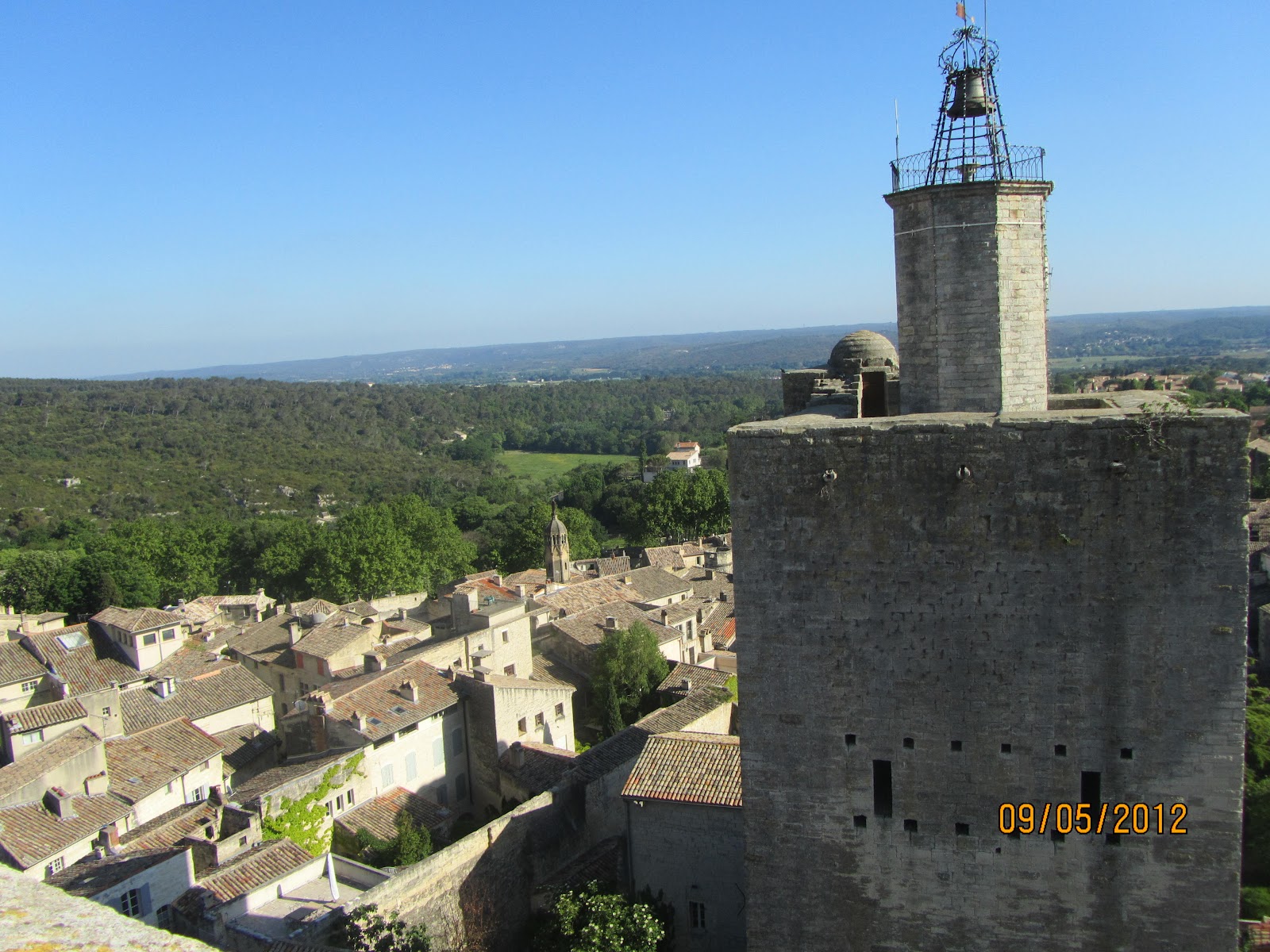
  View of the church with Fenestrelle Tower, akin to Italian campanile. It is allegedly the only round bell tower in France


                                        Who doesn't love flags in the wind? Uzes Duchy flag, the first duchy in France!


        The 12th- century Bishop's tower was the seat of the bishop's temporal powers up until the French Revolution.                          The tallest tower in the town is topped by an octogonal clock tower and belfry, added in the 19th century.


                                                          One of sentry boxes of the Belmonde tower
               The chapel rooftop from the "wrong" side...


                                                         and from the right one :) taken from here:
                                      http://www.flickr.com/photos/gaetanlee/2569342563/sizes/l/in/photostream/

So there it is. I'll repeat again- maybe something extra was included in that 12EUR ticket, but I didn't know. Anyway, read some reviews on tripadvisor and you'll see that almost everyone was very disappointed for various reasons and felt it was a rip-off. Unfortunately, I have to agree with them. When it comes to attractions, I don't ever recall paying that much money and getting so little.

Anyway, now something about the history of the castle: The Duke's castle (aka Duchy) was built on the remains of Roman Castrum. The wooden construction has not survived and very little is known about it. The first of two very important women to inhabit the castle was Dhouda, the first female writer of the Western World to write a book. She was the author of Liber Manualis, a handbook written in the 9th century for her son William. It is preserved until our days, but it is not kept in the castle. 
     During the difficult times of the Revolution the building was considered as belonging to the nation, and sold. It was much misused, and ended as a school. In 1824 the Duke bought back the Duchy of Uzès from the townspeople (the writer André Gide was one of them) who in buying it had actually protected it. In 1834 a new school was build in Uzes and the Duke set about restoring the Duchy of Uzès.
     The second important woman was Anne de Rochechouart Mortemart (1847-1933). She was a sculptor and early feminist. She is notable for being the first woman, along with Camille du Gast, to hold a driving license in France (1897), the first woman to be ticketed for speeding in 1898 (15 km/h instead of 12 km/h), and the first woman 'lieutenant de louveterie' (aka Wolfcactcher Royal, a person responsible for organizing all aspects of the wolf-hunt and presided over the royal pack of wolfhounds and their handlers). Now that's a real badass! And this is just half of the story. I think this woman deserves more recognition and I'm baffled that she barely has a page on wikipedia, and it's in French only!
    The first part of the 20th century saw sad days for the Duchy of Uzès. In financial difficulty, the Duke sold the furnishings and rented the Duchy of Uzès to the Board of Education who once again installed a school. They did not fulfill their obligation to care for the building and concreted both inside and out.
   From 1951 the widowed Marchioness of Crussol set about restoring the Duchy of Uzès that she had re-acquired with the help of the Fine Arts Ministry. Aided by her friend André Malraux, Minister of Culture under General de Gaulle, whom she had met in her Political Society Gatherings, she had the town of Uzes classed in 1964 as a heritage site, which greatly helped it after two centuries of being forgotten.
      Her grandson and his wife, the present Duke and Duchess of Uzes, are continuing the work started by the Marchioness. Since then major work has been done to the building, and furnishings and objects are regularly added to enrich the collections for the pleasure of the visitor. The Duchy of Uzès is a rare example in the 21st century of a family castle being completely restored.
     Well yeah, basically I just copy-pasted the history of the castle from the official site since I couldn't find any extra info in English. It's a very nice site, by the way.

How to reach Chateau: It is located in the centre of Uzes, so no problem here. You will see a few towers next to each other and one of them belongs to the castle.

Visitor info:

a) Opening hours:

The castle is open every day except December 25th.
From 1 Sept to 30 June: 10 - 12 am and 2 - 6 pm
July and August: 10 - 12.30 am and 2 - 6.30 pm

 Last entrance 1/2 an hour before closing time.

b) Admission

Visit of the Tower plus a guided visit to the Apartments and the Cellars:

 Adult                                    17€
 From 12 to 16 years             13€
 From 7 to 11 years                 6€
 Under 7's                              Free

Tower only

Adults or children                  12€

c) Contact:

Official website: http://www.duche-uzes.fr/home-en.php

Adress

Le Duché
Place du Duché
30700 UZES - FRANCE
Tél : +33(0)4 66 22 18 96

Administration

Le Duché d'Uzès - 9, Place de la Porte de Passy
75016 PARIS - FRANCE
Fax : +33(0)1 42 88 36 65
Email : duchy@uzes.com

d) What to do nearby: Except for the castle, the main attraction of this town is Haribo museum, but it is not really close to the centre. Also worth checking out are few museums, like Les Truffieres d'Uzes, Atelier du cafe, museum of pottery and medieval garden.

Every year the duché hosts many events held in the courtyard and ground rooms in particular the famous Musical Nights.

e) Multimedia:

If you want to read more about Uzes Duchy, but in French only: http://www.nemausensis.com/personnages/SagadUzes.htm


And here is nice insight into the castle where owner tries to justify the high admission. Apparently, he also lives there. I had no clue! http://www.discover-uzes.com/2011/08/meet-jacques-de-crussol-17th-duke-of-uz%C3%A8s-and-visit-his-castle.html

If you don't bother reading, you can get the tour of the castle on Saturday morning for a reduced price of 10 EUR :)